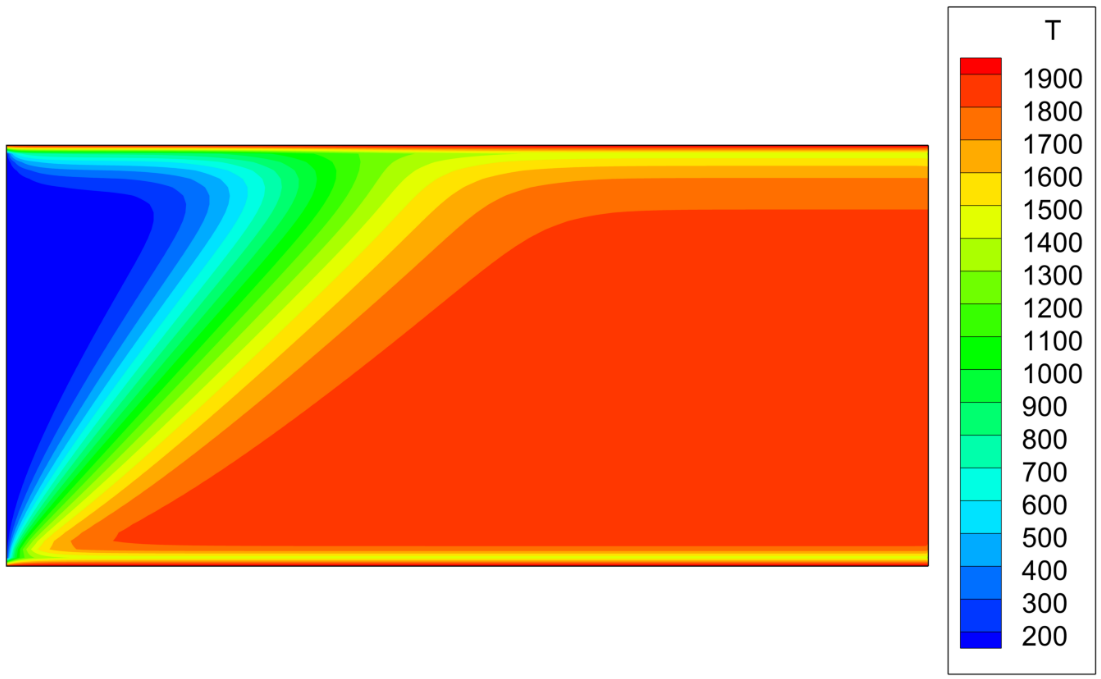
This project deals with the numerical analysis of two-dimensional heat transfer using partial differential equations. Algorithms such as central, upwind, and hybrid discretization methods are employed to solve these equations. Additionally, TDMA and ADI methods are used to solve the system of equations, and the obtained results are compared and analyzed across different methods.
In this project, the numerical solution of two-dimensional heat transfer equations is investigated using partial differential equations (PDEs). Heat transfer is a crucial phenomenon in various engineering applications, especially in the field of mechanical and energy engineering. The governing equations for heat transfer are solved using different discretization methods, including central, upwind, and hybrid approaches. The TDMA (Tri-Diagonal Matrix Algorithm) and ADI (Alternating Direction Implicit) methods are utilized to efficiently solve the resulting system of equations. By implementing these algorithms in a computational environment, the project aims to compare the accuracy and convergence of different methods, analyzing their strengths and limitations in capturing the physical phenomena of heat transfer.
In this project, the fluid flow between two flat plates is considered, where the fluid enters with a uniform velocity. The boundary conditions include a constant velocity at the inlet and constant temperature at the walls. It is assumed that at the outlet, the temperature gradient is zero, indicating fully developed thermal flow.
In the solution methodology, the two-dimensional heat transfer equation is discretized using methods such as central, upwind, and hybrid schemes. The resulting system of equations is solved using TDMA and ADI methods, and the results are compared to evaluate convergence and accuracy.
The governing equations for this two-dimensional heat transfer problem include the energy equation, which describes the temperature variations over time and space. The general form of the equation is:
Equation (1):

Where:
When φ is substituted with temperature T, the energy equation becomes:
Equation (2):

In this equation:
In Figure (1), it was found that increasing the velocity in the y direction significantly affects the temperature distribution within the domain. Higher velocities enhance the convection effect, leading to a more pronounced transport of heat. This results in steeper temperature gradients, particularly near the inlet where the fluid enters the system.
In short, the results demonstrate the impact of different discretization methods on the accuracy and convergence of solving heat transfer equations.
In conclusion, the results emphasize that choosing the right numerical methods and boundary conditions is crucial for achieving accurate and reliable results in numerical simulations of heat transfer.