Phone+98-912-028-0065

Brownian Force Validation with Developed Solver

Abstract

In this problem, the Brownian force acting on the particles in the fluid was investigated, and the accuracy of that force was also analyzed with an accurate solution. We obtained very good results from the solution, which proves that the developed solver fully realizes the external force.

1. Introduction

The Brownian force refers to the random forces acting on small particles suspended in a fluid (liquid or gas) due to the collisions with the surrounding molecules. This force is a result of the erratic and unpredictable motion of molecules in the fluid, and it is most noticeable at the nano and micro scales.

Characteristics of Brownian Force:

This force is recognized as a key factor in physical and chemical processes involving suspended systems. Or in other words, when a small particle is suspended in a liquid, it is affected by the impact of the liquid molecule. For very small particles (colloids), the sudden momentum transferred to the particle changes randomly, which causes the particle to move in a random direction, which today is called Brownian force.

2. Methodology & Solution

The particle diameter was 5 micrometers and the number of 51 particles was investigated. The Brownian motion of a small particle in a static fluid in the \(x\) direction is calculated by the Lagrangian equation (1):

(1) \( \frac{du}{dt} + \beta u = n(t) \)

The important parameter in Brownian motion is the diffusion coefficient, which is calculated from equation (2):

(2) \( D = \frac{KT}{\beta m} = \frac{KT C_c}{3 \pi \mu d} \)

3. Flow Simulation and Validation Results

The approach taken to calculate the Brownian force is as follows:

\( G_1 = \sqrt{-2 \ln(U_1)} \times \cos(2\pi U_2) \)

\( G_2 = \sqrt{-2 \ln(U_1)} \times \sin(2\pi U_2) \)

Then the range of Brownian force is calculated as follows:

(4) \( n(t_i) = G_i \sqrt{\frac{\pi S_{nn}}{\Delta t}} \)
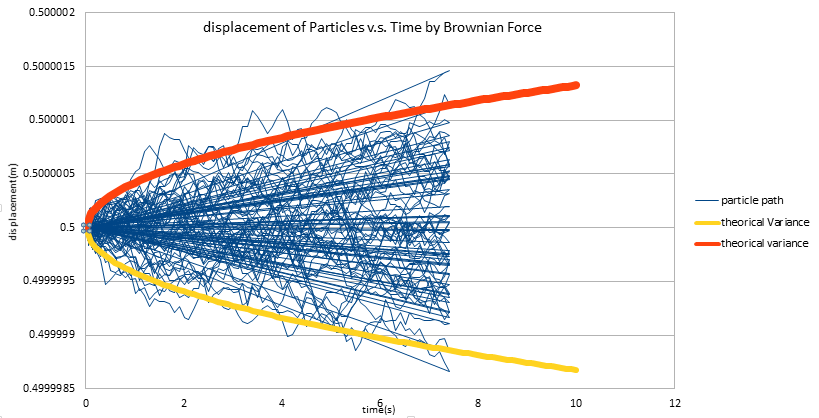
Figure 1: Comparison of the movement path of particles with respect to the theoretical range with respect to time

As can be seen from diagram 1, the movement and oscillation of the particles are correctly matched with the theoretical answer, and as a result, the correctness of the Brownian model was validated.