2. Methodology
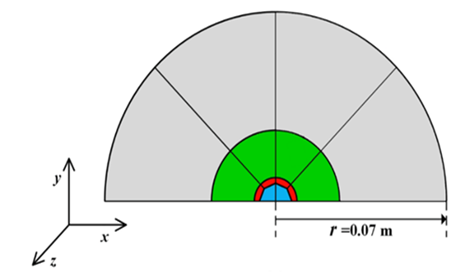
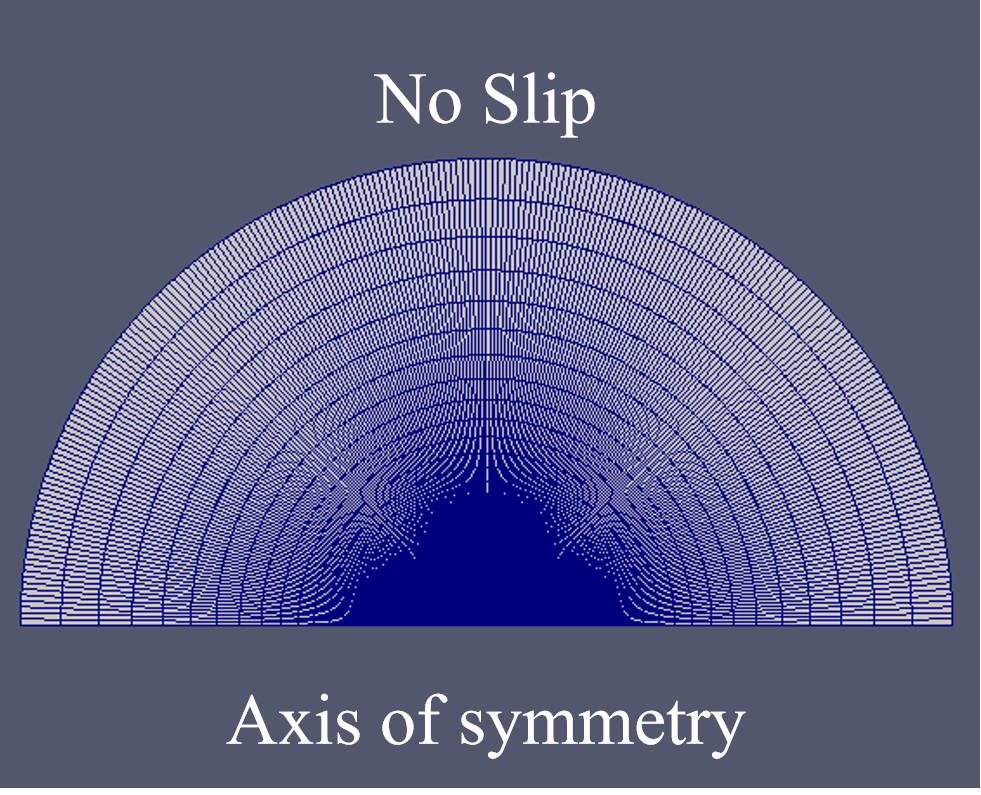
To simulate bubble collapse, a symmetric two-dimensional geometry in the form of a semicircle and wedge is used, whose dimensions and boundary conditions are as shown in Figure 1.
Author: Sajad Khodadadi
This research was done using compressible solver in OpenFoam software. Also, this article investigates the failure of a single bubble. Simulating single bubble failure is an important step in cleaning surface deposits, which must be done correctly. Finally, the simulation results of the accuracy of our OpenFoam solver were compared with Rönninger's [1] experimental solution and confirmed the accuracy of the solver.
Bubble Collapse has many uses in different industries, such as for removing kidney stones, delivering drugs to the brain, and surface cleaning, and also when two oil substances in the sea with different densities are mixed together in water, with the help of this method, this pollution can be removed. Removed from the water and separated the ingredients. Therefore, this issue is very important in industries and these applications will expand with the advancement of industry and technology.
To simulate bubble collapse, a symmetric two-dimensional geometry in the form of a semicircle and wedge is used, whose dimensions and boundary conditions are as shown in Figure 1.
In this problem, single bubble failure is investigated. Its properties as a gas follow the Van der Waals equation of state for a gas, and in a liquid it follows the Tate equation of state. Because in this problem, the energy equation is not considered, so the equation of states of the gas inside the bubble and the surrounding liquid are considered adiabatic.
![comparing the trend of changes in the radius between the developed solver along with the energy equation and Rönninger's experimental results [1].](../images/Bubble-Collapse/fig2.png)
As we can see in Figure 1, the developed solver can well model the process of radius changes both by applying energy equations and without applying them.
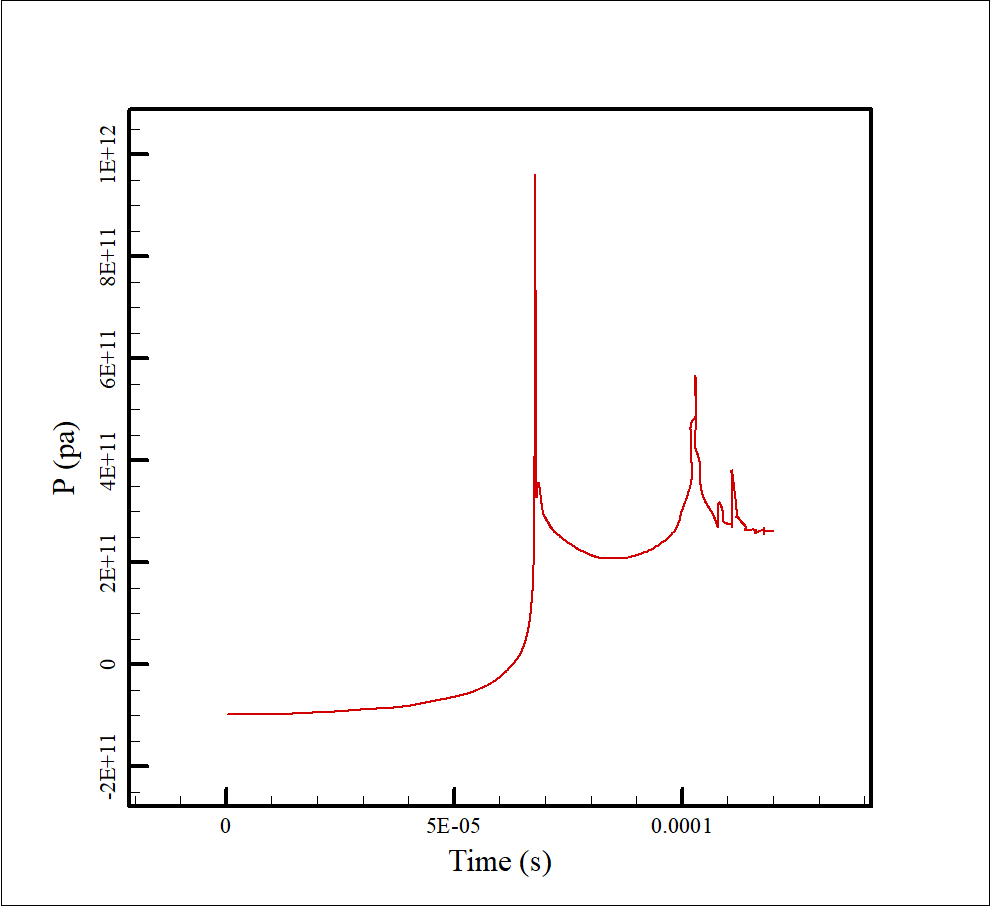
According to the graph of the pressure of the center of the bubble, it can be seen that at the beginning of the solution, when the pressure is set equal to 10 pascals, the pressure graph starts from the number of 10 pascals, and as the bubble gets smaller, the pressure of the center of the bubble takes an upward trend until At the minimum radius that occurs in the fracture process, the pressure reaches its maximum value, which is about 20 GPa. After that, the bubble that enters the growth stage, because of this, the pressure of its center decreases until the moment of reaching the second peak of the radius, when the pressure value reaches 15000 pascal.
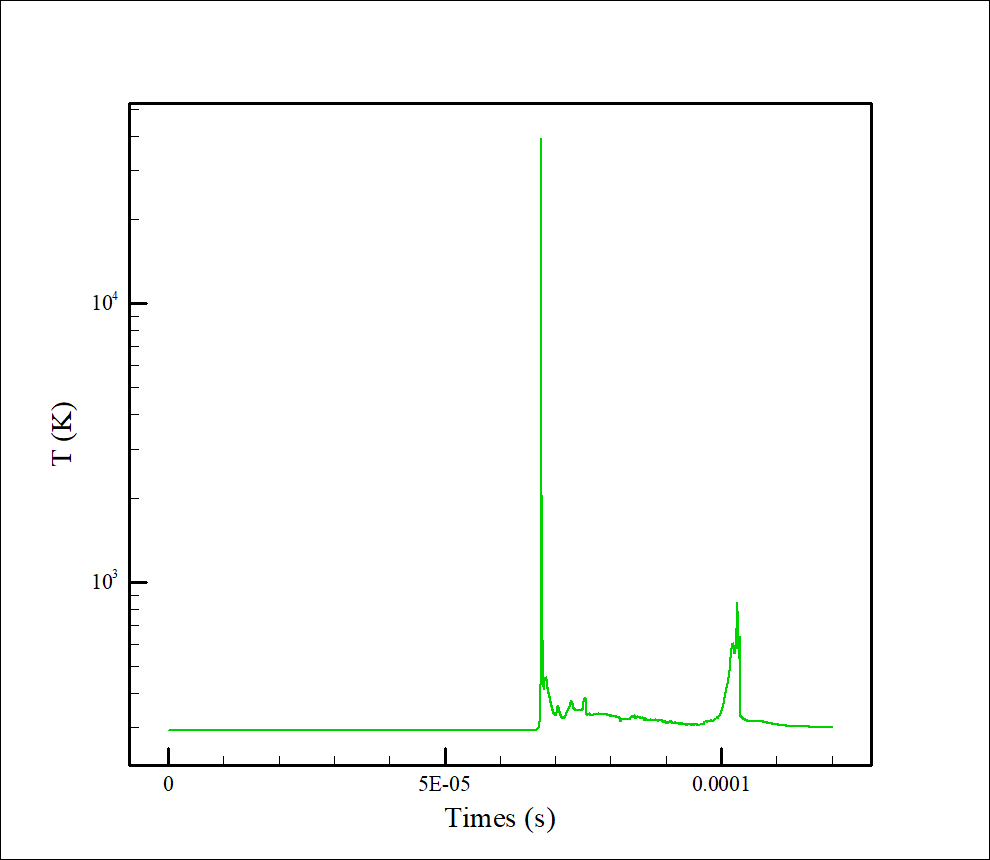
Finally, according to Figure 4, we see that due to the presence of the kinetic energy term in the energy equation, when the jet forms and passes through the center of the bubble, the temperature increases significantly at that moment, and the temperature does not increase significantly at other times.
[1] D. Kroninger, “Particle-tracking-velocimetry-Messungen an kollabierenden Kavitationsblasen, Doktorarbeit.,” Drittes Physikalisches Institut, Universität Göttingen vol. 6, 2008.