Sediment growth is a significant challenge in both natural and industrial processes. In this research, simulations of sediment layer growth are performed to address this issue. Flow parameters in this problem are calculated using Euler's method, and the Lagrangian method is employed to track particles with high accuracy near the surface. By using the Immersed Boundary Method (IBM), common errors such as negative volume encountered in moving meshes are avoided. Additionally, the lack of mesh regeneration in each time step reduces the computational cost by 30% compared to the moving grid method. The model was validated by simulating the flow around a pipe where soot particles were deposited on its front. Various parameters, including Young's modulus, Reynolds number, and particle diameter distribution, were studied.
The sedimentation phenomenon refers to the settling and accumulation of particles on surfaces, starting with the deposition of a single particle and potentially leading to a complete blockage of the flow path. The growth of a sediment layer can introduce numerous economic and operational issues, such as increased pressure drops (requiring stronger pumps) and decreased heat transfer efficiency (leading to higher fuel consumption). Due to the importance of this phenomenon and research gaps, many researchers have numerically studied sedimentation using various methods. Studies on sedimentation can be broadly divided into two categories: zero-dimensional models (analytical and semi-experimental) and numerical models. These approaches condense the complex physics of sedimentation into two processes: the sedimentation rate and the sediment removal rate. The difference between these two processes dictates the overall sedimentation rate.
The sediment layer acts as thermal resistance, reducing heat transfer from the pipe surface to the fluid. As the deposit grows, a temperature difference arises between the pipe wall and the surface of the deposit in contact with the fluid. The temperature of the pipe wall is provided as input, but the temperature of the deposit surface changes the fluid properties, influencing particle settling. To improve accuracy, conduction within the sediment layer must be considered. The governing energy equation is expressed as equation (1):
(1) \[ \frac{\partial (\rho c_p T)}{\partial t} + \frac{\partial (\rho c_p u_j T)}{\partial x_j} = \frac{\partial}{\partial x_j} \left( k \frac{\partial T}{\partial x_j} \right) \]
In this study, Equation (1) was used to investigate heat conduction in the sediment and solve the complete energy equation in the fluid. For the solid region, the velocity is zero, leading to the absence of a displacement term, leaving only the diffusion and unsteady terms in the equation. Due to the presence of the immersed boundary, the coefficient matrix is altered by the boundary condition.
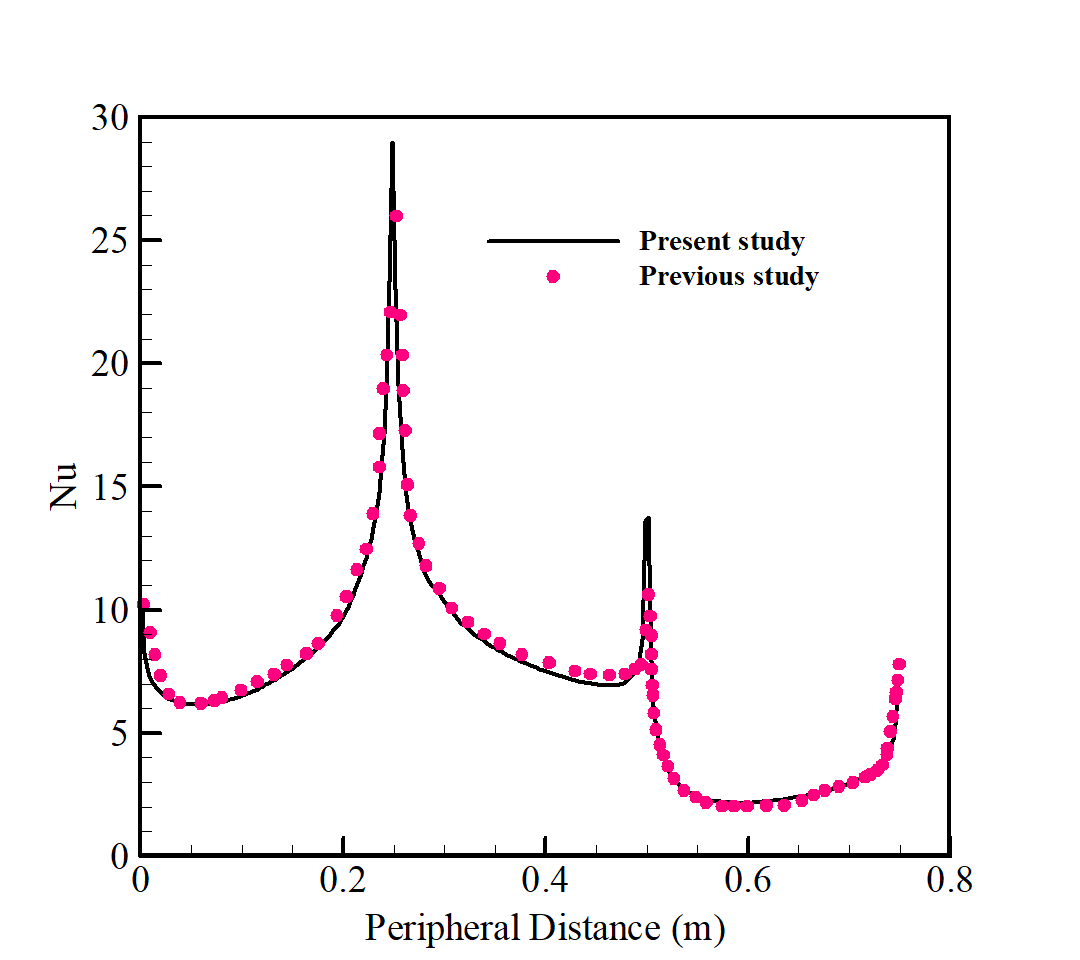
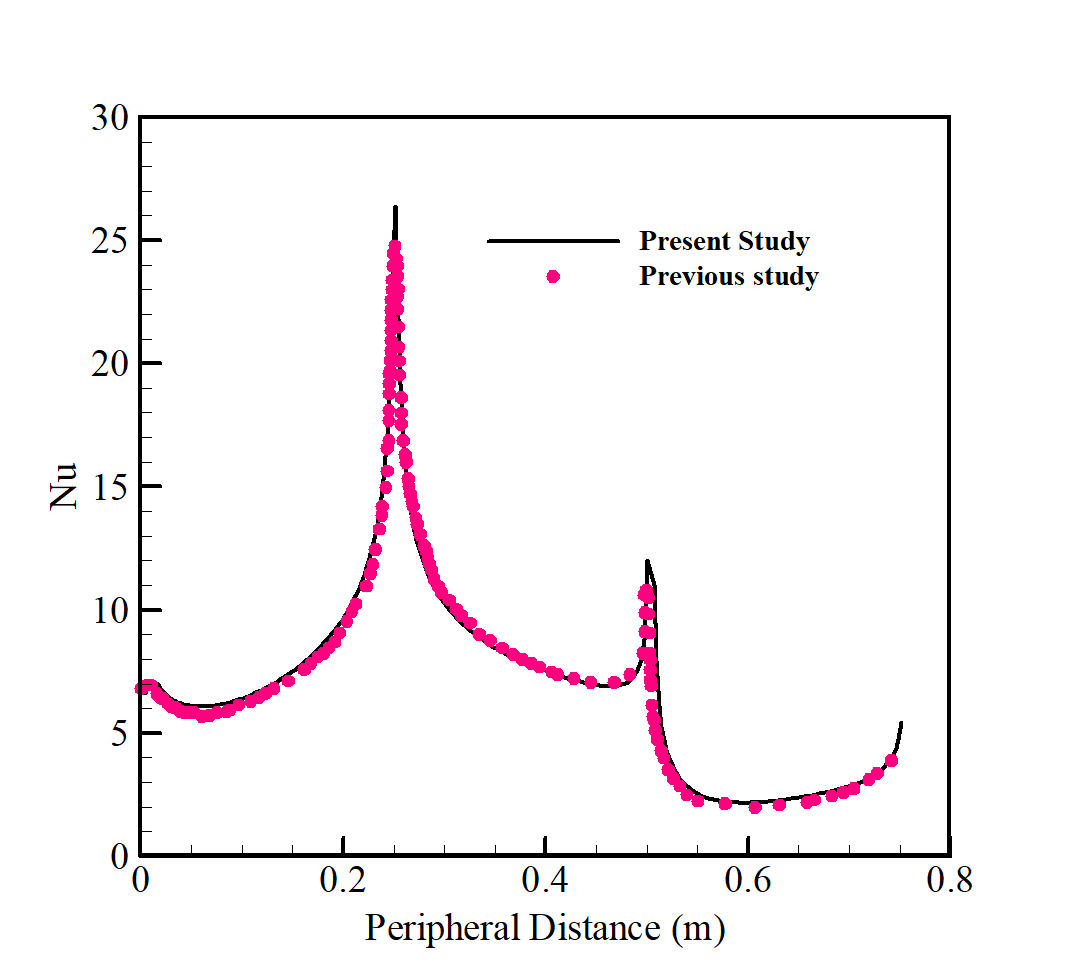
The results show good agreement, with a maximum observable error of 8%, attributed to the cut cell method in the immersed boundary method at corner points.