Author: : Mohammad Hassan Taleghani, Sajad Khodadadi, Reza Maddahian, and Manijhe Mokhtari-Dizaji
Affiliations: : Faculty of Mechanical Engineering, Tarbiat Modares University, Tehran, Iran
This study investigates the effects of electrohydrodynamic (EHD) force on bubble collapse energy enhancement, with potential applications in medical and industrial processes. By incorporating EHD force into bubble dynamics, a significant increase in velocity, pressure, and wall shear stress was observed. The results demonstrate that EHD improves the overall efficiency of bubble collapse, contributing to enhanced jet force and energy transfer.
The study of bubble collapse phenomena has been a critical area of research in fields like medical technology and fluid dynamics, particularly in the context of high-intensity focused ultrasound (HIFU), lithotripsy, and surface cleaning. This work expands on prior research by exploring the impact of electrohydrodynamic forces on bubble collapse energy. The primary goal is to evaluate how the application of electric fields influences the energy released during collapse, focusing on pressure, velocity, and jet formation.
The volume-of-fluid (VOF) method is employed to model bubble dynamics, incorporating both incompressibility and electrohydrodynamic effects. Governing equations for momentum, continuity, and electric field interaction are solved using OpenFOAM’s multiphase solvers. The bubble is initially positioned near a rigid wall, with varying non-dimensional distances and applied electric field strengths (capillary number CaE).
Figure 1-a shows the variations in bubble collapse velocity under different electric field strengths. As the electric capillary number increases, the velocity at the bubble center increases significantly, leading to stronger jet formation. Additionally, the pressure at the wall increases proportionally to the applied field, as demonstrated in Figure 1-b.
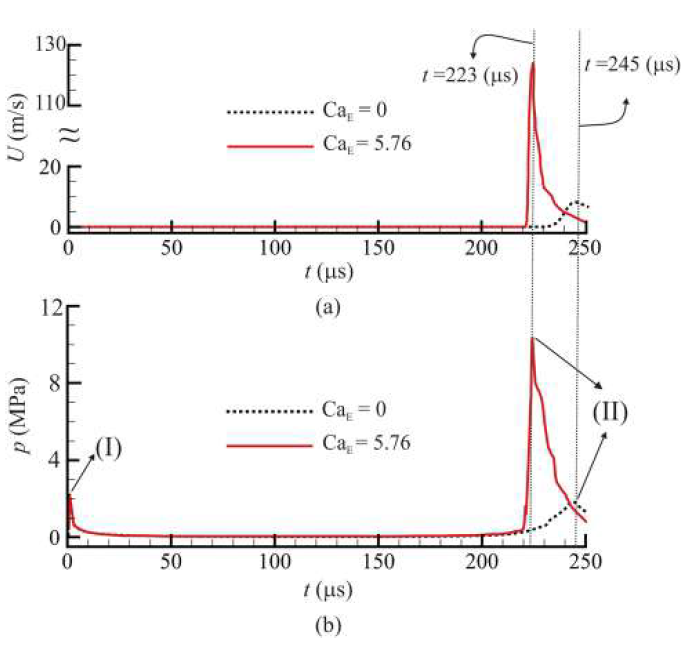
The introduction of electrohydrodynamic forces into bubble collapse dynamics leads to substantial increases in collapse energy and jet force. These findings could improve efficiency in industrial and medical applications that utilize bubble dynamics for processes like cleaning and drug delivery. Future work will investigate the optimization of EHD forces for specific applications.