Phone+98-912-028-0065

Investigating the interaction of bubbles on the flotation rate of solid particles

Abstract

This simulation was done in OpenFoam software. In the first part of this report, the flotation process and its application have been introduced. In the second part, the interaction of air bubble and mineral particles, which includes the collision, adhesion and separation of bubbles and particles, as well as the viewpoints that have been used for the numerical simulation of this process have been examined. Then, a number of experimental, analytical and numerical studies have been presented. By examining the mentioned cases, it can be concluded that the flotation process is one of the complex processes due to its multi-phase nature as well as the hydrodynamics of the system, the understanding of which has faced many challenges for engineers and scientists.

1. Introduction

Flotation is a process to separate high-grade mineral materials from low-grade materials. Today, due to the lack of mines and the reduction of their reserves, flotation is considered a vital process in the concentration and enrichment of mineral minerals.

The aim of this research is to numerically simulate the bubble interaction on the particle flotation rate solid to achieve the maximum recovery by performing the necessary optimization. For this purpose, after completing the research studies, the equations governing the Euler phase and the Lagrange phase were presented, and in order to check the accuracy of the developed solver, the continuous and discrete phases were validated with valid articles. After ensuring the performance of the solver, the simulation of strain and fracture of the bubble loaded by particles in simple shear flow and the integration of the pair of bubbles loaded by particles in static fluid flow were performed and the results were fully presented.

2. Methodology &Solution

In order to investigate the effect of shear flow on the flotation rate of solid particles, a two-dimensional geometry (rectangle) with a width of W and a height of H has been used in such a way that in its center there is a spherical bubble loaded with particles. The boundary conditions of constant velocity are set in opposite directions to obtain a symmetric shear flow in the direction of bubble elongation and rupture., Boundary condition of velocity at the entrance and exit of zero gradient. 0.08 for the upper wall and -0.08 for the lower wall.

The diameter of the bubble is set to 2 mm.

3. Flow Simulation and Validation Results

What was discussed as an innovation in the present work is actually the effect of bubble interaction on the rate of flotation of solid particles in such a way that if the bubble loaded by particles is stretched and broken, what effect does this process have on the rate of particle recovery. Also, the effect of the integration of the charged bubble pair in the static fluid on the separation of particles was also investigated. Since the simulation of this three-phase phenomenon is very complex and full of challenges, it is necessary to fully understand the physics of three-phase flow in order to derive the equations, simultaneous simulation of three phases and considering the interaction between phases. For this purpose, three-phase simulation was performed with fluid volume and Lagrangian approach, considering incompressible fluid. The fluid volume method solves a Navier-Stokes equation for the mixed phase by considering the weighted average of the properties of the liquid phase (liquid) and the air phase (bubble). On the other hand, the Lagrangian approach adds eyes to the Navier-Stokes equation using the second law of Newton-therm. The relevant simulation equations are used, but the important point is to ensure the solver used in the OpenFoam software, for this reason, continuous phase and discrete phase validations were done before the simultaneous simulation of three phases, and after proving the correctness of the results, Simulation of air bubble loaded by particles in shear flow was discussed.

In this Reynolds simulation, the constant flow is set in the range of laminar flow and by changing the dimensionless capillary number, the elongation and break of the air bubble loaded by observed particles and the number of particles remaining on the surface of the bubble during the simulation time are reported.
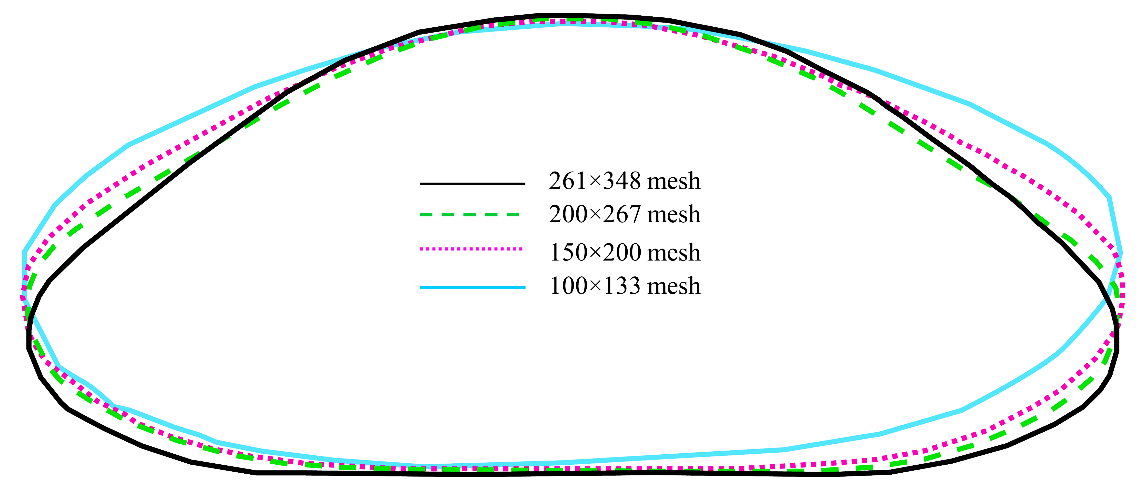
Figure 1 The contour of the interface of the bubble for the value of alpha is equal to 0.5

To evaluate the independence of the solution from changes in the computational grid, as described in the independence section related to bubble failure. Necessary measures were taken. Finally, to achieve the independence of the solution from the computing network, alpha contour was examined for the value of 0.5 for four different networks. As can be seen in Figure (1), the results for the 267 x 200 and 348 x 261 networks have very little difference with each other, so we are allowed to use one of these two networks for simulation so that logical and correct results are obtained.
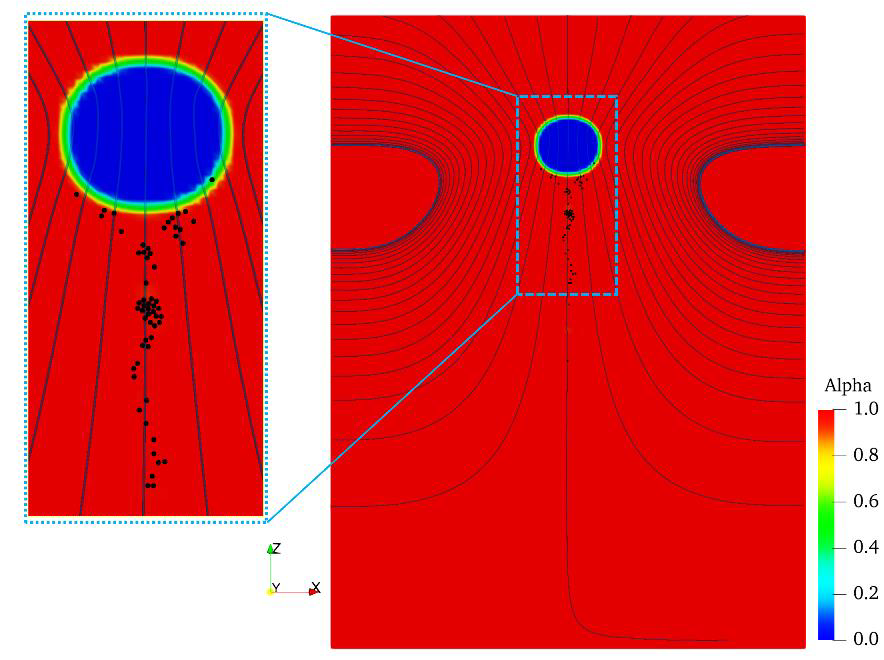
Figure 1 The contour of the interface of the bubble for the value of alpha is equal to 0.5
Figure 2 the contour of the interface of the bubble in the duration of 0.22 seconds

And many other results were obtained that are not included here.

4. Conclusion

This study classifies bubble-wall interactions into three regimes based on wall inclination and bubble size. The findings contribute to better understanding the bubble behavior in industrial applications like heat exchangers and electrolysis cells. Further experimental studies are recommended to validate the proposed regime map under various conditions.