Phone+98-912-028-0065

Numerical Investigation of Peristaltic Flow in the Obstructed Human Ureter using the Moving Immersed Boundary Method

Author: Ahmad Hosseini

Supervisors: Dr. Reza Maddahian, Dr. Sajad Khodadadi

Abstract

This study models urine flow in the human ureter, both with and without blockages, using the Immersed Boundary Method (IBM). The simulation, which is cost-effective and independent of geometry, shows only a 1% error compared to analytical solutions.

It explores how different blockage percentages, peristaltic wavelengths, and wave amplitudes affect kidney stone movement and urine flow. Findings suggest that less blockage or increased wavelength and amplitude reduce stone excretion time.

However, more obstruction, higher amplitude, and shorter wavelength increase the risk of backflow and reflux. Wave amplitude has the most significant impact on stone movement and urine flow rate.

1. Introduction

The human ureter, part of the upper urinary tract, transports urine from the kidney to the bladder using peristaltic pumping. This study simulates peristaltic flow in the ureter, with and without obstructions, using the Immersed Boundary Method (IBM), which is cost-effective and geometry-independent.

The simulation shows a 1% error compared to analytical solutions in estimating flow rate reduction due to reverse pressure. It examines how blockage percentage (0-60%), peristaltic wavelength (30-90 mm), and wave amplitude (1-2.5 mm) affect kidney stone dynamics and urine flow. Results indicate that stone excretion time decreases with less blockage or increased wavelength and amplitude.

Increased obstruction, higher amplitude, and shorter wavelength raise backflow and reflux risk. Among these parameters, wave amplitude significantly impacts stone movement and urine flow rate.

The innovations of the present work can be listed as follows:

2. Validation of Results
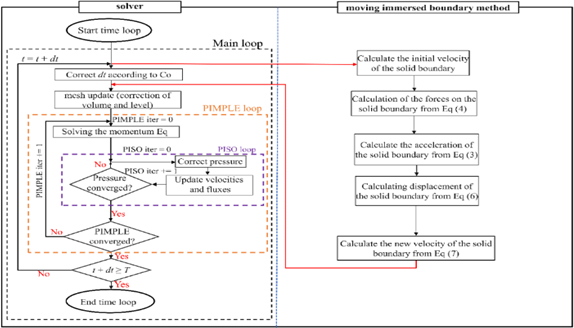
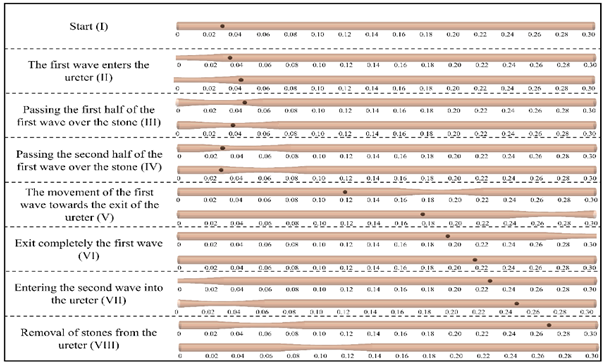
Figure 1: Flow chart of the implementation and solving the governing equations of the moving immersed boundaries surface method

Figure 2: The schematic of the considered model and the peristaltic wave propagation

Figure 2: The schematic of the considered model and the peristaltic wave propagation

2.2 validation of stable bubble

When a microbubble is situated within an infinite environment and initially subjected to a pressure, the bubble's radius will exhibit a continuous fluctuation due to the symmetry of the system. This ensures that the bubble will not fail. The simulation geometry is a two-dimensional, symmetrical semicircle.
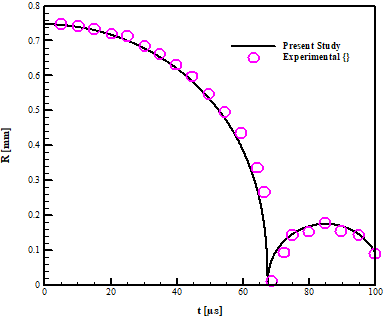
Fig2 A comparative analysis of the changes in bubble radius between the current simulation results and those reported by Ronninger in his research..
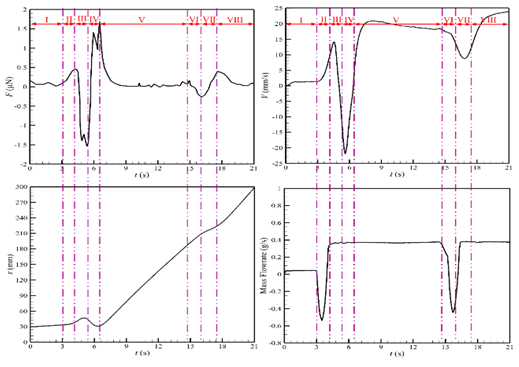
Figure 3: Temporal evaluation of stone excretion in the human ureter for a stone with a diameter of 3.13 mm, 20% blockage, and a ureter length of 300 mm a) net force acting on the stone, b) stone velocity, c) stone location, and d) mass flow rate at the ureter inlet

Table 1: Test cases considered for the purpose of parametric study
Test case Blockage ratio Wavelength (mm) Wave amplitude (mm) Stone diameter (mm) Mass (g)
TC2 0 60 1.5 0 0
TC3 10 60 1.5 2.21 0.012433
TC4 40 60 1.5 4.42 0.099466
TC5 60 60 1.5 5.42 0.183403
TC6 20 60 1 3.13 0.035322
TC7 20 60 2.5 3.13 0.035322
TC8 20 30 1.5 3.13 0.035322
TC9 20 90 1.5 3.13 0.035322

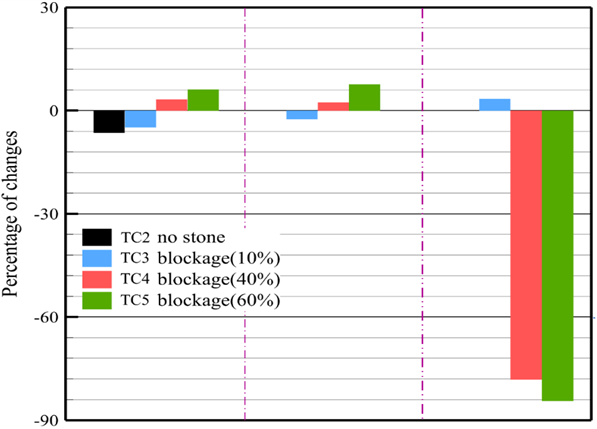
Figure 4: Variations due to changes in the percentage of obstruction compared to the case with 20% obstruction (TC1) in a) maximum backflow, b) stone removal time, and c) maximum recession(maximum observed backward motion) of the stone in the ureter

Table 2: Examining the effect of peristaltic wavelength on the studied parameters in the ureter
Test case Changes in the time of stone exit Changes in the Average mass flow rate passing through the inlet in the stage (V) Changes in the Maximum flow rate Changes in the maximum return movement of the stone
TC8 9.05% -29.5% 24% -11.25%
TC9 -2.02% 21.9% -13.3% 2.5%

4. Conclusion

This paper investigates urine transport in both normal and obstructed ureters using numerical simulations. It examines how blockage percentage, wavelength, and amplitude of peristaltic waves affect kidney stone dynamics and urine flow rate. The simulations, performed with a modified immersed boundary solver in OpenFOAM, consider three degrees of freedom. Key findings include:

  1. The position of the stone relative to the peristaltic wave influences the force on the stone, affecting its movement direction and speed.
  2. Higher blockage percentages reduce the stone’s backward movement, increase backflow, and prolong stone expulsion time.
  3. Greater wave amplitude decreases backward stone movement, increases backflow, and shortens expulsion time.
  4. Longer wavelengths enhance backward stone movement but reduce backflow and expulsion time.
  5. Overall, larger amplitude and wavelength waves expedite stone removal but increase the likelihood of reflux.