2. Methodology
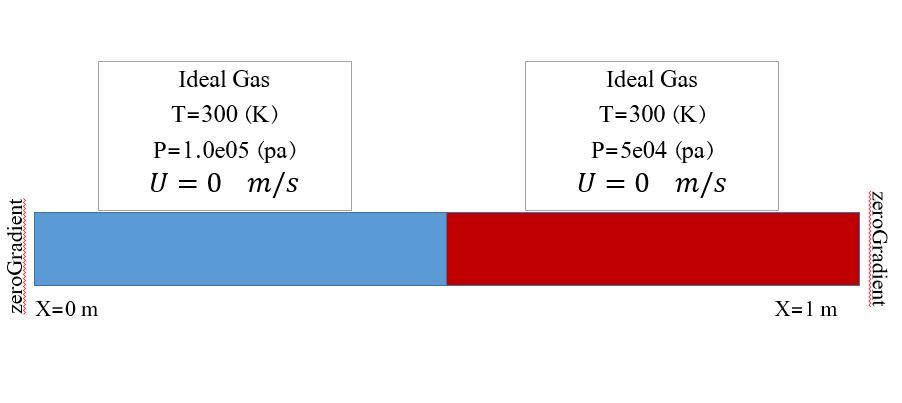
A rectangular channel with a length of 1 m is used. Both sides of the channel contain two high-pressure gases with different pressures. The schematic of the geometry is shown in Figure 1.
Author: Sajad Khodadadi
This research was done using a compressible solver in OpenFoam software. This problem examines shock waves. Because this problem is a very important basis for simulating the problem of single Bubble Collapse, it is necessary to do it correctly. Finally, the simulation results of the correctness of our OpenFoam solver were compared with the analytical solution and confirmed the correctness of the solver.
When the bubble collapses, it emits a powerful wave called the shock wave, and as mentioned, this issue is a basic issue for numerical simulation of Bubble Collapse. The power of this wave has the ability to destroy the sediments on the surface and therefore it is an important issue.
A rectangular channel with a length of 1 m is used. Both sides of the channel contain two high-pressure gases with different pressures. The schematic of the geometry is shown in Figure 1.
Removing the diaphragm momentarily or instantly creates a wave that is high pressure and the direction of that wave is from the high pressure ideal gas to the low pressure ideal gas, which causes changes in pressure, density and speed. It can be Also, all these changes affect the energy equation and cause changes in temperature. This problem has an analytical solution, and the present results in the analytical solution [1] and the present numerical work are displayed in the form of figures (2) and (3), which show complete agreement.
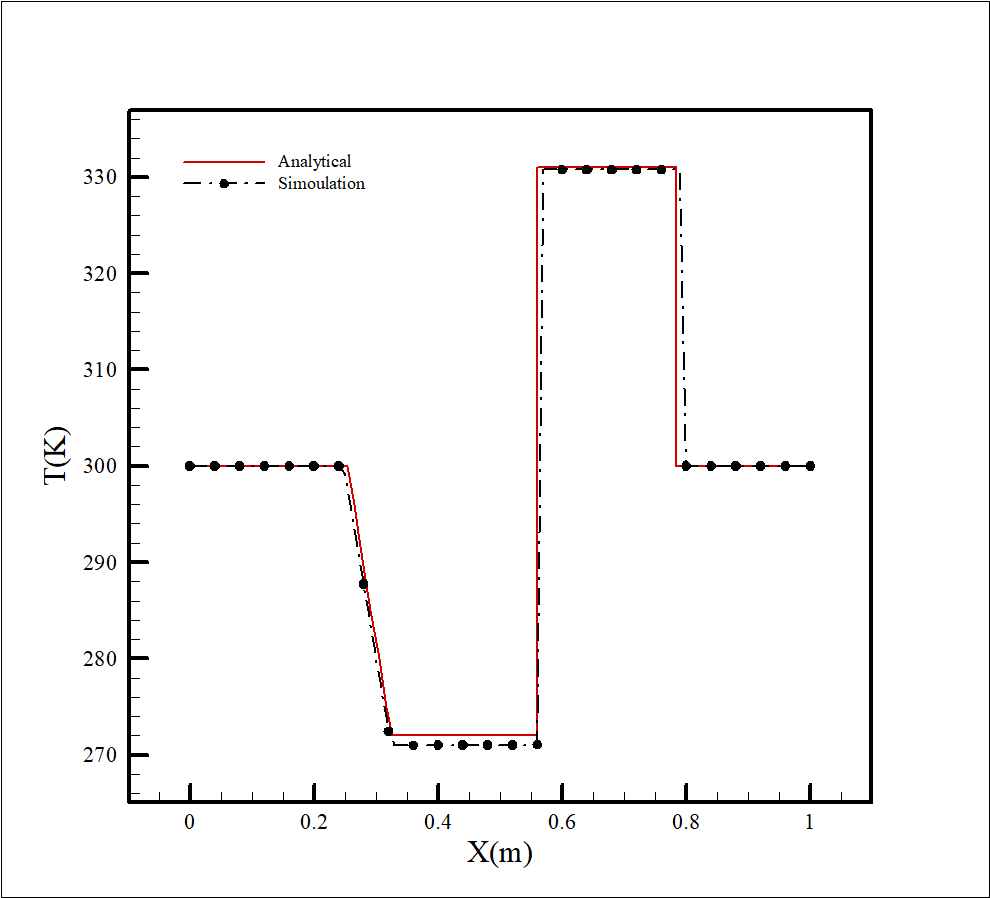
![Figure 3 Comparison of the pressure changes created between the present numerical work and the analytical work at t=0.7ms [1].](../images/Shock-Tube/fig3.png)
It can be stated that with the formation of waves, the temperature of the high pressure part decreases and on the other hand, the temperature of the low pressure part also increases. Also, after the formation of the wave, the pressure on the side of the high-pressure gas decreases, and as a result, the density also decreases. Therefore, it can be stated that the velocity, pressure and density equations are correctly related to each other and the solver models this problem well, which is the basis of the bubble breaking problem.
[1] Alexandre Martin, Jean-Yves Trépanier, Marcelo Reggio, “ Numerical solution of axisymmetric Multi-species compressible gas flow: Towards improved circuit breaker simoulation,” Journal of Computational Fluid Dynamics, 2008