2. Methodology
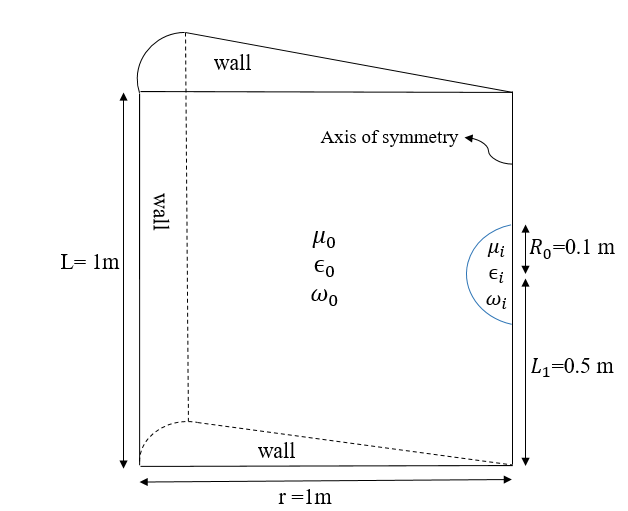
The desired geometry is a pipe wedge whose angle is 5 degrees and its dimensions are 1m x 1m. The schematic of the desired geometry, the boundary conditions and the position of the bubble are shown in Figure (1).
Author: Ali Dalvand
Supervisor: Dr. Reza Maddahian, Dr. Sajad Khodadadi
This research was done using compressible Lagrangian solver in OpenFoam software. The basis of this research is based on surface cleaning using bubble collapse. As earlier in our research, we correctly simulated the bubble break, which is the basis for reducing or removing sediment, we went to this topic, which is one of the applications of bubble break, and we achieved very good results. This issue is very important in industries such as cleaning heat exchangers, removing kidney stones, etc.
Surface cleaning using bubble breaking is one of the important issues that is needed more and more with the progress of industries, science and technology. Zhang et al[1], investigated a surface with sediment. They came to the conclusion that by increasing the pressure to 413.7 kPa, all the pollution was removed from the surface. According to the studies done on this topic, we came to the point that the particle in the Lagrangian perspective has not been investigated in other researches, we will investigate it in this research and publish the cleaning power for different number of particles.
The desired geometry is a pipe wedge whose angle is 5 degrees and its dimensions are 1m x 1m. The schematic of the desired geometry, the boundary conditions and the position of the bubble are shown in Figure (1).
The solver is a one-way coupler and observes the effects of the continuous phase on the particles. Pimple algorithm is used for velocity and pressure coupling. First, we checked the drag force, lift and pressure gradient on the particles and made sure that both the particles and the solver understand these forces correctly. Then the particles were deposited at the bottom of the container and a bubble collapsed near them and the particles were completely lifted from the surface.
[1] Aliasghar Ghadimkhani, Wen Zhang, Taha Marhaba, “Ceramic membrane defouling (cleaning) by air Nano Bubbles”,2016