Author: Ahmad Hosseini
Supervisors: Dr. Reza Maddahian, Dr. Sajad Khodadadi
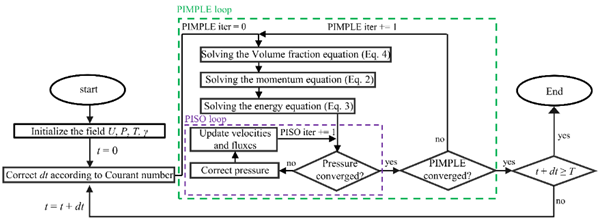
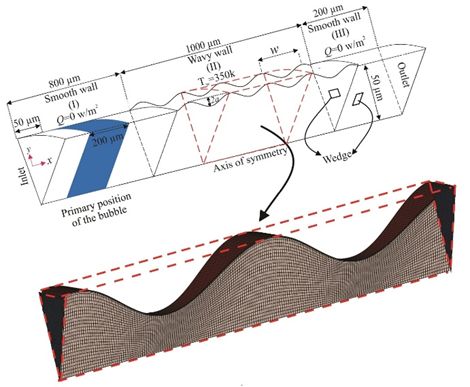
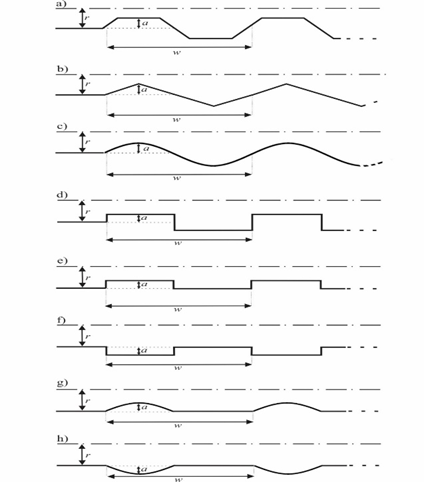
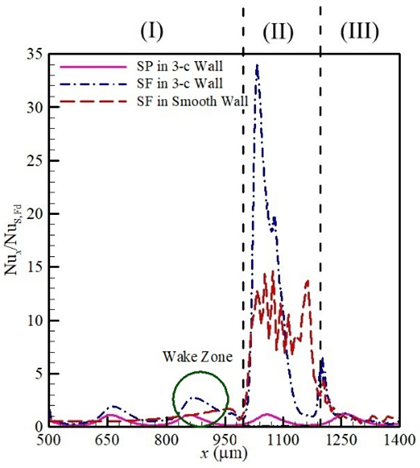
The research explores how altering wall shapes and using slug two-phase flow can improve heat transfer in heated wavy wall microtubes. By employing a modified volume of fluid method, the study captures the interface between two phases and compares the heat transfer effect of a single Taylor bubble across eight wall shapes. The best shape increased heat transfer by 50% compared to smooth walls. Additionally, the study investigates the influence of wavelength and wave amplitude on heat transfer in a modified geometry of consecutive half-sines. Optimal values of 100 microns for amplitude and 20 microns for wavelength resulted in a 2.5 times increase in heat transfer compared to slug flow and an 11 times increase compared to single-phase flow in smooth walls. The combined effect of heat transfer and pressure drop was also analyzed, showing limited negative impact of increased pressure drop on heat transfer. Two accurate correlations for the average Nusselt number and TPF were presented.
The innovations of the present work can be listed as follows:
| Figure | 3-h | 3-g | 3-f | 3-e | 3-d | 3-c | 3-b | 3-a |
|---|---|---|---|---|---|---|---|---|
| "Average of Nū" | 18.285 | 25.183 | 11.055 | 14.030 | 18.327 | 20.294 | 19.922 | 18.651 |
| Numax | 19.698 | 37.1467 | 16.2092 | 17.5016 | 26.0303 | 26.9974 | 28.9043 | 31.1529 |
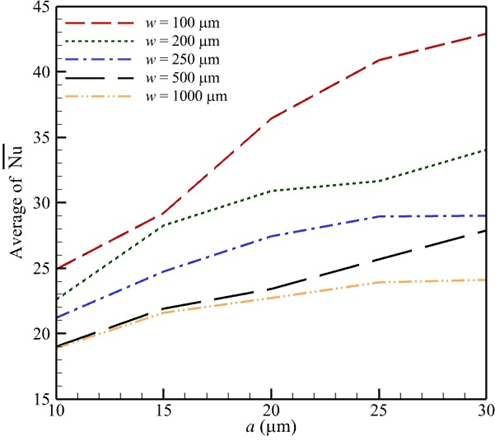
The research aimed to study Taylor bubbles in wavy microtubes and find a wall geometry that enhances heat transfer. Using OpenFOAM, various geometries were tested, focusing on maintaining an acceptable pressure drop. Key findings include: